
Artificial Intelligence: The Rise of Agentic AI
From Digital Assistants to Autonomous Workers
What investors need to know about the technology reshaping the global economy
1. What is Agentic AI?
For the past two years, most people have experienced artificial intelligence as a chatbot. You type a question, it answers. Then it sits there, cursor blinking, waiting for your next instruction. This model—sometimes called co-pilot AI—is useful, but fundamentally passive. It is a clever assistant that never takes initiative.
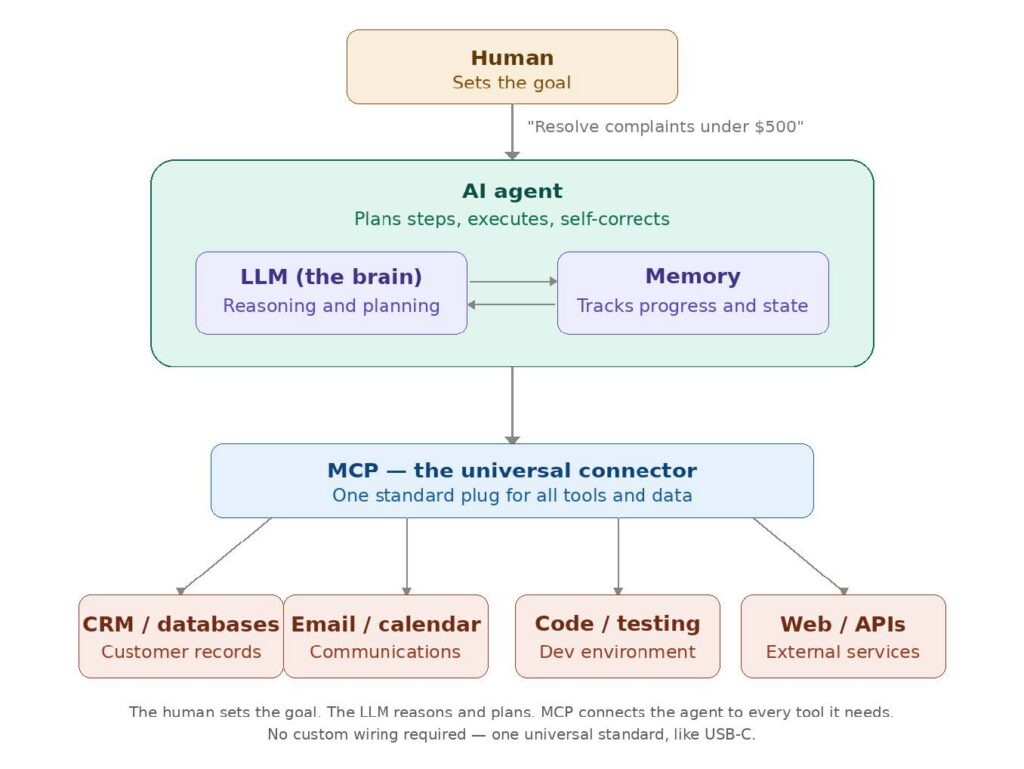
Agentic AI is qualitatively different. Give it a goal—“Find the cheapest flights to Tokyo for these dates, cross-reference with hotel availability near Shibuya, and book the best combination under $3,000”— and it breaks the problem into steps, uses multiple tools (flight databases, hotel sites, a calendar), backtracks if a lead is a dead end, and delivers a finished result. The human sets the destination; the agent drives the car.
How It Works Under the Hood
Three innovations have converged to make this possible.
The brain: large language models. Models like ChatGPT, Claude, and Gemini are the reasoning engines. They are akin to extremely well-read graduates who have absorbed most of the internet. They can process, plan, write, and make judgements. A brain alone is not enough. We also need hands and a way to interact with the world.
The plumbing: a universal connector called Model Context Protocol (MCP). MCP enables the AI engine to connect to systems where work can get done. With MCP, agents can access customer databases, accounting software and logistics platforms, for instance. Until recently, every connection had to be custom-built, like wiring a new plug for every appliance in your house.
In late 2024, Anthropic introduced MCP which is essential one standardised socket that enables AI agents to plug into any data source or tool. By February 2026, MCP had crossed 97 million monthly downloads and adopted by major AI providers. It is the industry standard and is now governed by the Linux Foundation, co-founded by OpenAI, Google, Microsoft, Amazon, and others.
The training leap: Autonomous learning. In the early days, AI was trained by having humans grading its outputs. This was slow and expensive. A newer approach – Reinforcement Learning with Verifiable Rewards (RLVR) – gives the model automatic, objective feedbacks. The model iterates thousands of times at machine speed, teaching itself through trial and error. This is why coding agents have improved at a pace that has stunned even the people building them.
Where Things Stand Today
The industry crossed a “chasm” in late 2025. The landmark event was the launch of the latest update of Claude Code from Anthropic. Claude Code was then capable of compressing a year’s development work into hours or days, according to one of its senior software engineers. In early 2026, NVIDIA reported 64 per cent of organisations actively deploying AI in operations, with a vast majority seeing productivity gains. PwC found 79 per cent of 300 company executives they surveyed in 2025 were already leveraging agentic AI, with two-thirds reporting measurable productivity improvements.
The agent market is projected to surge from ~US$8 billion in 2025 to over US$50 billion by 2030, according to market research firm MarketsandMarkets. Agentic AI is no longer a laboratory curiosity.
2. What Agents Can Do: Real Examples, Real Results
Tools like Claude Code, OpenAI Codex, and Cursor now build entire software features autonomously. A developer provides a specification (prompt), such as to “Build a secure login system with encrypted tokens and full test coverage”, and the agent will then design the architecture, write codes across multiple files, generate tests, fix what breaks, and submit the finished product. A task that would take two days previously can now be delivered in minutes.
Another field where agentic AI is making wave is customer service. Salesforce’s Agentforce 3.0 automates 85 per cent of tier-1 support inquiries and 60 per cent of routine sales follow-ups for enterprise clients. The agents don’t just answer questions, they proactively identify upsell opportunities in existing accounts without human prompt. Cost per interaction: ~US$0.40, versus $2.70–$5.60 for a human agent.
Oracle reports customers have reduced invoice processing cycles by 80 per cent using predictive agents that reroute shipments based on real-time logistics data. PepsiCo, working with Siemens and NVIDIA, converted US factories into high-fidelity 3D digital twins, virtual replicas where AI agents simulate operations before any physical changes are made. This resulted in 20% throughput increase and 10–15% reductions in capital expenditure.
Amazon used its coding agent to modernise thousands of legacy Java applications in weeks rather than years. Anthropic’s Claude can now interact with software that has no modern programming interface. The AI “sees” the screen and operates mouse and keyboard like a human, bridging the gap to old enterprise systems that companies have been unable to upgrade for decades.
The Cost Equation
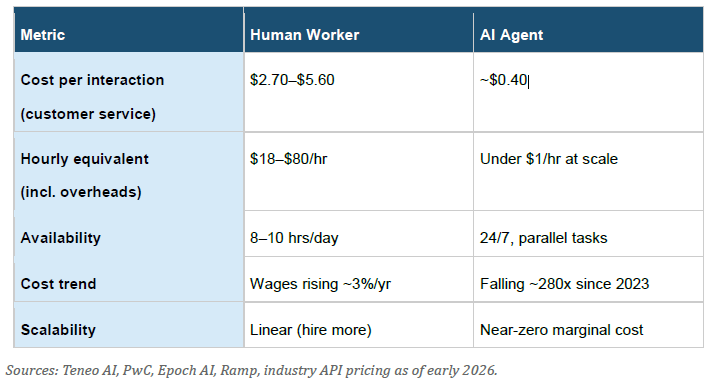
The unit cost of running AI, measured in tokens, has plummeted. In 2022, a million tokens cost around US$20. By late 2025, tokens from lightweight models hit US$0.15, a 99% decline. Three forces are driving down the cost of tokens:
- NVIDIA’s ever more efficient new AI chips
- Improvement in models and algorithms
- Aggressive competition from new entrants undercut prices
A basic coding assistant like GitHub Copilot costs just US$10 per month which is trivial relative to a developer’s salary, yet capable of making developers far more productive. Noticeably, full agentic coding tools cost as little as US$20 per month. Every quarter, agents get smarter and cheaper. For high-wage, services-heavy economies, the incentive to deploy agents is acute.
3. Why Agentic—Not Co-Pilot—Is the Killer App
A co-pilot is like a knowledgeable colleague helping us. We ask, they answer, then stop and wait. We still manage the workflow, decide what’s next, copy information between systems. The human is the engine; the co-pilot is a mere productivity boost.
An agentic system is more like hiring a competent employee. You say: “Resolve all outstanding customer complaints. Anything under $500, handle it. Anything above, escalate with a summary.” The agent will then read tickets, pull up history via MCP, draft responses, process refunds, flag high-value cases, and report back at day’s end. We only need to define the goal and do not need to prompt each step (if the agent is trained properly).
Another example is supply chain management. When we ask, “What’s the status of shipment #4471?”, a co-pilot will only return an answer as of that point in time. In comparison, an agent will monitor the shipment continuously, when it detect that a road closure will delay #4471, it will find an alternative route, rebook the freight, update the customer portal, and send another notification, before you know there is a problem.
The co-pilot answers questions about the world, the agent manages and reacts to forces in the world.
The architecture enabling this at scale is the multi-agent system: teams of specialised agents coordinated by an orchestrator, like a project manager assigning tasks to specialists. One agent generates code, another tests it, a third checks for security vulnerabilities, and the orchestrator coordinates. Gartner predicts that by the end of 2026, 40 per cent of enterprise applications will feature task-specific agents, up from less than 5 per cent in 2025. Among companies measuring returns on generative AI, average ROI is 49 per cent, with 92 per cent of early adopters reporting positive results, according to recent report from Snowflake (an AI Cloud company).
4. Broader Implications
i. Why Coding Is Just the Beginning
The fact that coding is verifiable makes it the first area in which agentic AI has made an impact. An agent writes a program, runs tests, and gets an instant pass-or-fail verdict, the perfect training loop for RLVR.
Other domains are going to be disrupted by AI. Legal compliance (does this clause satisfy regulation X?), financial reconciliation (do these numbers match the audited figures?), A/B-tested marketing copy (does this version increase conversions?), and diagnostic imaging (does this scan match established clinical criteria?) all provide objective quality measures. As verification tools and domain-specific benchmarks mature across industries, agents will be disruptive and offer significant productivity uplift.
Revenue per employee in AI-exposed industries has surged 27 per cent since 2022—over three times the growth elsewhere. According to a PWC report, workers with AI skills earn a 56 per cent wage premium, more than double the prior year. Meanwhile, 69 per cent of workers expect agents to take over parts of their job within 12 months.
ii. Software Industry: Moats Under Siege
For two decades, SaaS companies bill their customers based on number of seats per month. The economic moats were strong as they are around user habits, interface design and data lock-in. Part of the economic moats is a result of switching costs of user habit and interface familiarity.
Agentic AI inverts this. When an agent can operate a customer relationship management software or manage a project board without a human logging in, companies can cut back their software subscriptions sharply.
A leaked memo from a Fortune 50 company revealed plans to cut its Salesforce and ServiceNow licence spend by 60 per cent, opting instead to use raw API credits from AI model providers.
The issue is that agents are becoming a new operating layer between users and software, potentially changing the way we interact with software. An agent orchestrates actions across different software behind the scene with users entering natural language commands. When natural language is the interface, software interface design matters less. When MCP lets any agent plug into any system, proprietary integrations matter less. When an agent can learn to operate any software in minutes by “watching” the screen, switching costs evaporate. Pre-AI agents, getting humans to do their jobs inside your software was a powerful moat. If agents are doing the work, who cares about human workflow?
This extends to the broader internet economy. If agents increasingly handle research, shopping, and service interactions on behalf of users, the advertising-supported models that underpin much of the web face a fundamental question: who sees the ad if an agent is doing the browsing? When an agent researches a purchase, compares options, and completes a transaction without a human ever visiting a website, the entire value chain of digital advertising, from impression to click to conversion, is potentially disrupted.
This does not mean these businesses disappear overnight, but their economic moats are under pressure from a direction few anticipated even two years ago.
iii. Workforce Reorganisation: Unpredictable Ripple Effects
If agents absorb entire job functions, corporate structure changes fundamentally. The future may be one of skilled humans orchestrating specialised AI agent teams!
The implications cascade in ways that are difficult to predict. Fifty per cent fewer customer service staff means fewer HR managers, smaller offices, fewer software licenses, different training programs, and reduced demand for the SaaS tools those employees used to rely on.
Each layer of workforce reduction triggers second- and third-order effects on enterprise spending that ripple through the entire software supply chain. This is precisely why the impact on SaaS software stock valuations is so hard to forecast. The magnitude of change depends not just on how good agents get, but on how radically companies are willing to redesign their operating models.
Gartner predicts 35 per cent of point-product SaaS tools will be replaced or absorbed by 2030, but the remaining 65 per cent will need to reinvent themselves around outcomes rather than seats. Another future vision is individuals commanding AI workforces rather than human staff. That is, solo founders deploying agent fleets to build products, analyse markets, and launch companies.
The World Economic Forum’s “Future of Job Report 2025” projected a net gain of 78 million jobs by 2030 (170 million created, 92 million displaced). The transition will be uneven and the ultimate shape of the global workforce remains uncertain.
Conclusion
Agentic AI is not another incremental software upgrade. It is a structural shift in how economic output is produced, from that of humans using tools to humans directing autonomous systems that execute work on their behalf.
The technology is real and maturing fast. Agentic AI economics are compelling. Real-world applications, from coding to claims processing to supply chain orchestration, are already in production at scale.
For investors, the second-order effects may matter most. Will agents become the primary users of digital services? Will attention-based business models erode? Are per-seat SaaS pricing models facing an uncertain future? Will corporations fundamentally re-organise their workforces to incorporate AI agents?
The direction of travel is clear, the pace is faster than any prior technology cycle, and the time to understand agentic AI is not next year. It is now.
At Ox Capital, we are focussed on investing in quality franchises with profitable long-term sustainable growth at attractive entry points. Current valuations are providing lots of interesting opportunities. Let us know if you would like to understand specifically where we are finding the opportunities!
Important Information: This material has been prepared by Ox Capital Management Pty Ltd (Ox Cap) (ABN 60 648 887 914) Ox Cap is the holder of an Australian financial services license AFSL 533828 and is regulated under the laws of Australia. This document does not relate to any financial or investment product or service and does not constitute or form part of any offer to sell, or any solicitation of any offer to subscribe or interests and the information provided is intended to be general in nature only. This should not form the basis of, or be relied upon for the purpose of, any investment decision. This document is not available to retail investors as defined under local laws. This document has been prepared without taking into account any person’s objectives, financial situation or needs. Any person receiving the information in this document should consider the appropriateness of the information, in light of their own objectives, financial situation or needs before acting. This document is provided to you on the basis that it should not be relied upon for any purpose other than information and discussion. The document has not been independently verified. No reliance may be placed for any purpose on the document or its accuracy, fairness, correctness, or completeness. Neither Ox Cap nor any of its related bodies corporates, associates and employees shall have any liability whatsoever (in negligence or otherwise) for any loss howsoever arising from any use of the document or otherwise in connection with the presentation.